
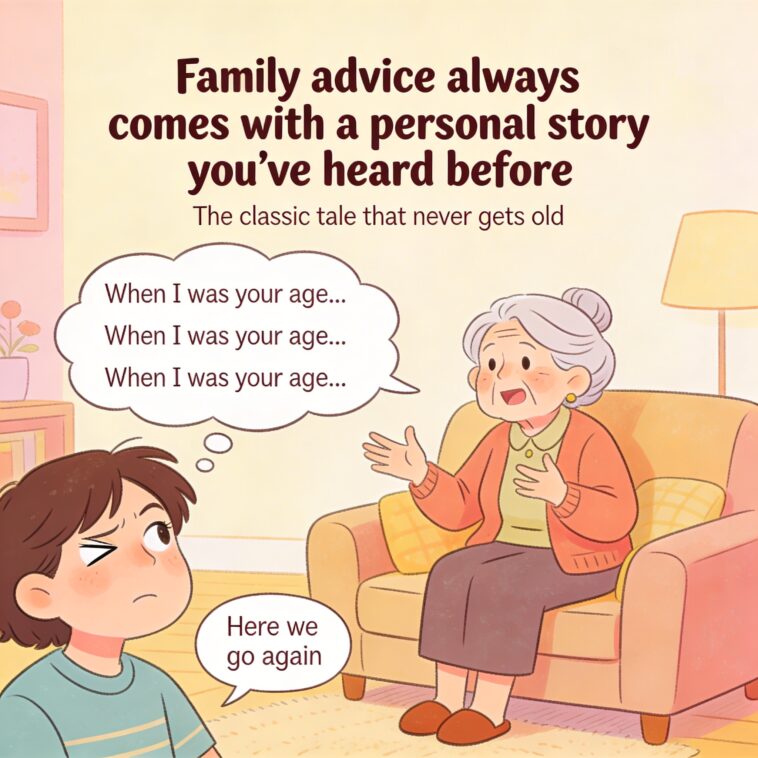
There are two types of advice in life:
- Advice from professionals
- Advice from family members, which is 100% identical… but comes with a story you’ve already memorized
You could be asking something simple like:
“Should I eat more vegetables?”
And suddenly you are not receiving nutrition guidance.
You are entering a time loop.
Because your family member will respond:
“You know, when I was your age…”
Oh no.
Here it comes again.
The story.
Not a new one.
Not a refreshed version.
The exact same story, with the same emotional pauses, the same conclusion, and somehow… the same unnecessary detail about the weather that day.
You already know the cast.
You already know the outcome.
You could perform it yourself.
But you must listen anyway.
Because interrupting is illegal in family advice format.
The Structure of Family Advice
Family advice always follows a strict formula:
1. The Setup
“Let me tell you something…”
This is where your hopes briefly rise, thinking this might be new.
They are not.
2. The Flashback Begins
“Back in my time…”
Time travel has started. You cannot exit.
3. The Completely Unrelated Struggle
Somewhere between:
- walking 5 km in the snow
- surviving on bread and determination
- or fixing a problem that is not your problem
You start wondering:
“Is this about vegetables anymore?”
No.
It is about character development.
4. The Life Lesson
“That’s why you should always…”
Finally, the advice appears.
Wrapped in 7 minutes of storytelling and emotional detours.
The Funny Part
The story is always delivered like it’s the first time.
Every. Single. Time.
Even though:
- You’ve heard it at birthdays
- You’ve heard it at dinner
- You’ve heard it while trying to watch TV
- You’ve heard it so many times you can predict the next sentence like a movie script
And yet, your family member is fully convinced they are introducing groundbreaking content.
“Did I ever tell you this?”
Yes.
In multiple formats.
Director’s cut included.
The Advice Never Changes
Here are examples of “new advice”:
- “Work hard.” (from a 12-minute farming story)
- “Don’t waste money.” (from a 1998 shopping incident)
- “Eat healthy.” (from the Great Sugar Incident of Unknown Year)
- “Be patient.” (after narrating a 3-hour queue situation)
The advice is simple.
The storytelling is… not.
The Real Mystery
The real question is not why family advice includes stories.
It’s why the story must be repeated in full HD detail every time the topic changes slightly.
Ask about:
- school → story about work
- work → story about childhood
- food → story about hardship
- technology → story about “back in my day, we didn’t have phones”
At this point, “advice” is just a trigger word for storytelling mode.
The Loop Never Ends
You try to escape it by saying:
“Yes, I know that story.”
Big mistake.
This only activates:
“Oh, you remember it? Let me explain it properly again.”
And now you are in the extended edition.
With bonus scenes.
Final Reality
Family advice is not really about solving your problem.
It’s about ensuring that a story—carefully preserved, emotionally refined, and slightly exaggerated over the years—continues to live on.
So yes, you asked about vegetables.
But what you received was:
- a life lesson
- a historical reenactment
- and a story you could perform from memory
And somehow…
it still worked.