here is a fundamental law of household physics:
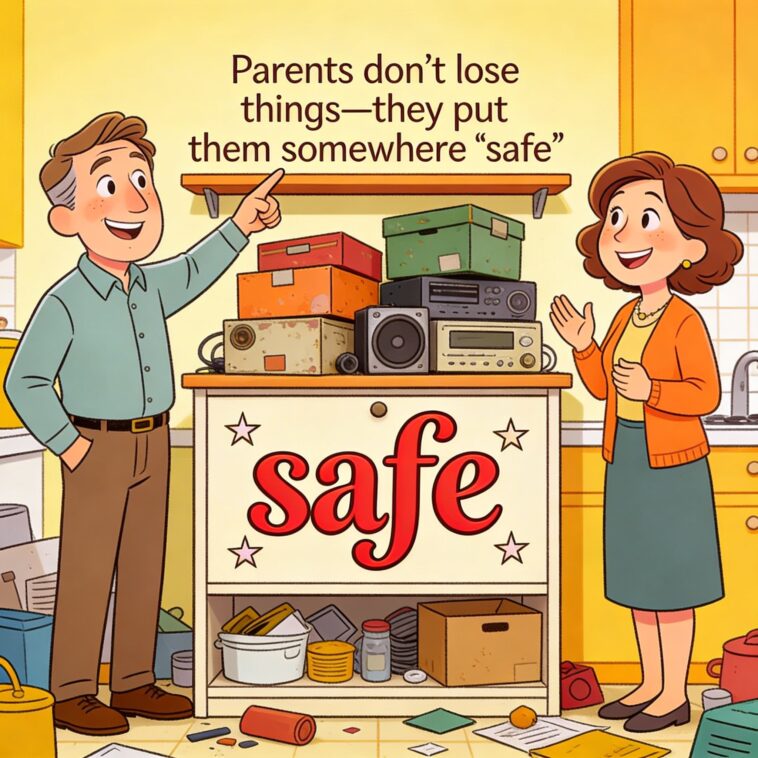
If a parent cannot find something, it is not lost. It is “safe.”
This is not a hypothesis.
It is a belief system.
Because in every home on Earth, the same conversation happens:
“Where are my glasses?”
“I put them somewhere safe.”
Now, “somewhere safe” is not a location.
It is a spiritual dimension where objects go to retire.
Keys? Safe.
Remote control? Safe.
Your birth certificate? Extremely safe (possibly too safe).
That thing you needed 3 minutes ago? Emotionally secure in another universe.
Meanwhile, you are searching like an archaeologist in distress.
You check:
- tables
- drawers
- fridge (just in case life has escalated)
- your own hands (humbling moment)
And then your parent walks in, opens a completely random cabinet, and says:
“Oh, here it is.”
No celebration. No explanation. Just casual discovery.
Like the object chose to return.
The funniest part is the confidence.
Parents don’t guess where things are.
They know.
Even if the thing was last seen in 2009.
“It’s probably in the blue basket.”
There are twelve baskets.
None are blue.
One is technically a bucket.
But somehow… it’s there.
And when you question the system, you get the classic response:
“I didn’t lose it. I just moved it so it wouldn’t get lost.”
This is like saying:
“I hid the fire extinguisher inside the fire.”
The concept of “safe places” also evolves over time.
Level 1: obvious drawer
Level 2: behind random objects
Level 3: inside a box labeled “misc”
Level 99: inside another box inside another box inside a place no human will emotionally recover from
And yet, parents always assume you should be able to find things.
“It’s right there.”
Where “there” means:
- behind a curtain
- inside a bag
- under something that looks like furniture but is actually storage
- or in a dimension where only parents have access privileges
Meanwhile, children develop survival skills:
- memorizing chaos geography
- tracking object migration patterns
- learning to ask multiple times before giving up on existence
Because if you don’t ask again, the item may remain “safe” forever.
The most powerful moment is when the parent re-loses the thing they just found.
It enters a new cycle.
Lost → Safe → Re-lost → More safe than ever
At this point, the object is basically being emotionally adopted by the house.
But here’s the truth:
Parents don’t lose things.
They simply assign them temporary invisibility for testing purposes.
And somehow…
they always pass the test.