
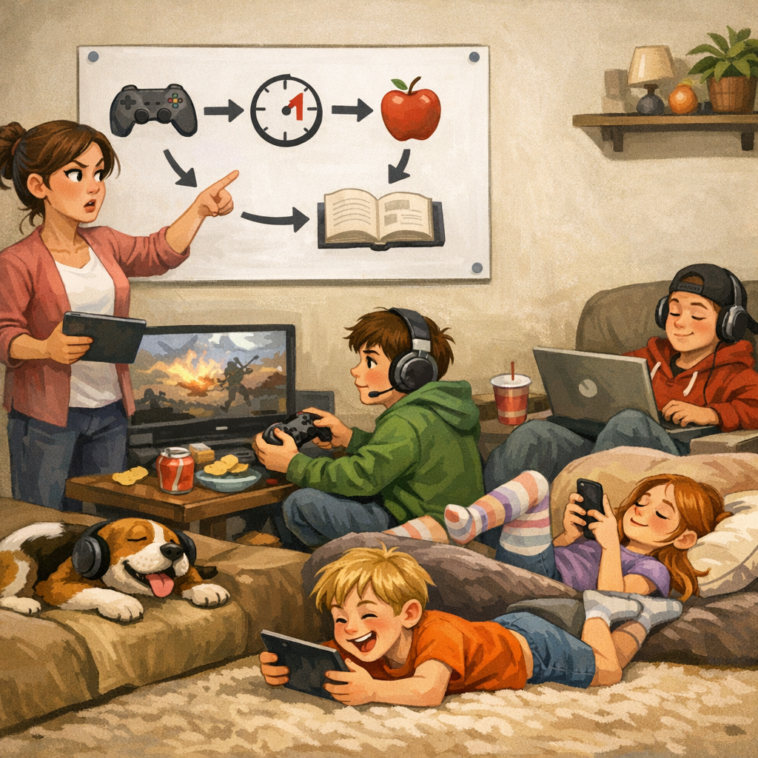
Every household has them.
Written with confidence. Stated with authority. Enforced with the energy of a government policy.
And then immediately ignored by everyone living in the house.
Yes, we’re talking about screen time rules.
Rule #1: “Only 1 hour per day”
A beautiful idea.
A noble concept.
A complete fantasy.
In reality:
- 1 hour becomes “just finishing this episode”
- which becomes “this is educational”
- which becomes “it’s basically research”
- which becomes 3 seasons later and emotional attachment to fictional characters
Technically still “learning.”
Rule #2: “No screens before bed”
This rule is respected for exactly 7 minutes.
Then:
- “just one video”
- “just one scroll”
- “just checking something quick”
Suddenly it is 1:47 AM and you are watching:
“Why medieval farmers had strange tools explained in 22 minutes”
Completely necessary information.
Rule #3: “Homework first, then screens”
This rule is accepted in theory.
In practice:
- homework is placed next to screens
- screens are looked at “for inspiration”
- inspiration turns into distraction
- distraction becomes lifestyle
Homework is still there.
Emotionally present, physically untouched.
Rule #4: “No screens at the table”
This rule dies instantly.
Because the table now includes:
- someone showing a funny video
- someone “just replying quickly”
- someone holding the phone under the table like a secret agent
Even the vegetables feel ignored.
Rule #5: “Weekend limits still apply”
This is where rules go to retire.
Weekend screen time is not measured.
It is experienced.
Time becomes:
- stretchy
- unpredictable
- slightly concerning
You check the clock and it says 2 PM.
You blink.
It is suddenly 7:30 PM and you have learned nothing except 14 new opinions about fictional universes.
Rule #6: “Only educational content”
Everything becomes educational if you believe hard enough.
Examples:
- gaming → hand-eye coordination research
- memes → cultural studies
- random videos → “language exposure”
- scrolling → “digital literacy training”
Parents cannot argue with science that doesn’t exist.
Rule #7: “Turn it off when asked”
This rule is universal.
Also universally delayed.
It usually triggers:
- 5 more minutes negotiations
- emotional bargaining
- sudden interest in finishing “just this part”
Turning it off takes longer than the screen time itself.
Final Truth
Screen time rules are not rules.
They are:
- intentions
- suggestions
- emotional agreements between hope and reality
And somehow, every day ends the same way:
“Okay, last video.”
Followed by seven more videos.
Because screen time doesn’t end when the timer says so.
It ends when the internet decides you are done.