
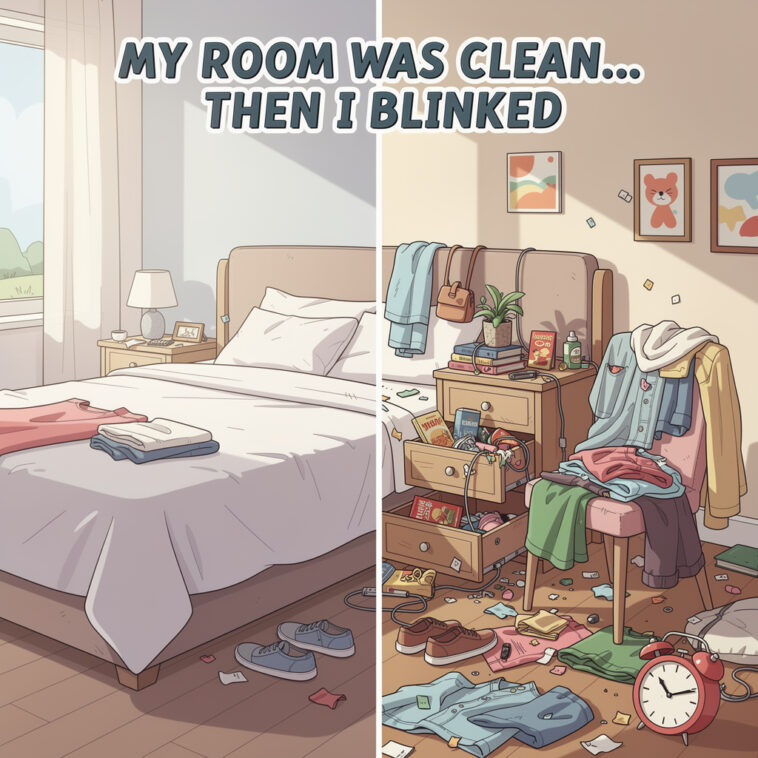
There are rare moments in life that feel almost spiritual.
A clean room is one of them.
You stand in the doorway, admiring your accomplishment like you’ve just climbed a mountain or paid a bill early.
Everything is in place:
- floor visible
- desk slightly organized
- bed made in a way that suggests hope
- chair not mysteriously buried under clothing
You think:
“I’ve changed. I’m a responsible person now.”
And then you blink.
That’s where everything goes wrong.
The First 0.3 Seconds After the Blink
Nothing seems different.
The room still looks clean.
This is the calm before the chaos realizes it has permission to return.
Your brain relaxes.
Dangerous mistake.
The Slow Return of Reality
It starts subtly.
A shirt appears on the chair.
You don’t remember putting it there.
But it feels… familiar.
Like it always belonged there.
Then a second item appears.
Then a third.
You begin to suspect your room is reproducing when you’re not looking.
The Floor Becomes Fiction
At some point, the floor stops being a surface.
It becomes a suggestion.
You vaguely remember it existing, but now it is covered by:
- clothes
- a charger you’ve never seen before
- a receipt from a life decision you regret
- and something that may or may not be a snack
Walking becomes an archaeological expedition.
You lift one item and discover three more beneath it like a nesting doll of chaos.
The Chair Situation Escalates Immediately
The chair is no longer a chair.
It is now:
“temporary storage ecosystem”
You consider sitting on it.
Then you remember you value your safety.
So you don’t.
The chair wins.
The Desk Slowly Loses Its Identity
At first, it’s just a desk.
Then:
- pens multiply
- papers stack themselves like they are forming a society
- cables intertwine like they are emotionally attached
You start to suspect the desk is trying to become something else.
Maybe a storage unit.
Maybe a museum.
Maybe a cry for help.
The Blink Effect Explained
Scientists (me, staring at my room) have concluded:
Cleaning a room has a half-life.
It decays faster if:
- you exist in it
- you place “just one thing” down
- or you say the phrase “I’ll put this away later”
Especially that last one.
That is how chaos evolves.
The Final Stage: Acceptance
You stand again at the doorway.
But now the room is different.
Not messy exactly.
More like:
“organized confusion with emotional history”
You sigh.
Not in defeat.
In recognition.
Because you know the truth:
Your room was never clean.
It was just briefly in recovery.
And blinking?
That’s just when reality checks in to continue the process.